



If a sweater has shrunk, stretched or pilled before a workday or event, do not spend the remaining time testing heat, steam or another wash. Identify the type of change, read the complete care label, gather matching pieces and confirm the ready time after the garment has been inspected.
Start with the wear time and the exact problem
Write down the date and hour the sweater must be worn. Then place it flat in strong neutral light and compare both sides. Shrinkage usually shows as shorter body length, tighter sleeves or dense texture. Stretching appears as dropped shoulders, a longer hem or rippled ribbing. Pilling sits on the surface at places that have rubbed against the body, a jacket, a strap or a seat belt.
Those observations lead to different next steps. A little surface lint is not the same as pills. A wrinkle is not necessarily stretched yarn. A sweater that feels smaller but still has open, flexible loops presents a different question from one that has become thick and felted. Note color change, stains, snags and seam strain before touching the garment with a tool.
Alameda Dry Cleaners is in the Pavilions center on W. Alameda Ave, with parking at the door for a quick garment handoff.
If the sweater needs care before a fixed wear time, Call or bring the complete outfit in and confirm the ready time after inspection.
Run one controlled inspection before choosing a method
- Lay the sweater on a clean lint-free surface and smooth it without pulling the knit.
- Compare sleeve length, shoulder position, side seams, hem and ribbing from left to right.
- Check the underarms, elbows, sides and front edge for pills, shine, thinning and snags.
- Read the fiber content, wash or dry-cleaning direction, drying method and every warning.
- Photograph the current shape and bring any matching cardigan belt, detachable collar or companion piece.
A label is written for the entire product. Federal Trade Commission guidance says care instructions must account for components such as non-detachable trim, buttons, zippers and decoration. That means a washable fiber body does not automatically make a structured front band, leather patch, bonded decoration or contrast panel suitable for the same home cycle.
Separate safe home care from deadline risk
| What you find | Next step | Deadline risk |
|---|---|---|
| Washable knit with no damage | Follow the exact cycle, temperature and drying instruction; support the garment throughout handling. | Low only if enough time remains for complete drying and a second fit check. |
| Dryclean Only instruction | Do not wash. Keep the label attached and request a garment assessment. | High if another home treatment is attempted. |
| Dense texture with smaller dimensions | Stop heat, water experiments and forceful stretching. | High because felting may be irreversible. |
| Long shoulders or hem | Keep the knit flat and record the present measurements without tugging. | Medium to high because wet weight or storage may have distorted the structure. |
| Pills with sound fabric | Clean by the approved method, then groom lightly on a flat surface. | Medium because rushed shaving can snag yarn or expose a thin patch. |
| Stain snag hole or loose seam | Leave the area untreated and show staff exactly what happened. | High because cleaning, repair and finishing require one coordinated plan. |
The table does not promise a result. It sets a stopping point so the remaining time is not consumed by a process that worsens the condition. At intake, state what the sweater must coordinate with and whether the dimensions changed before or after washing.
Do not make the dryer or steamer your rescue plan
Tumble drying belongs only to a sweater whose care label allows it, at the stated setting. Extra heat cannot reliably return a stretched knit to its former shape. One panel may contract while another remains long, and tumbling adds friction that can create more pills. Woolmark recommends flat drying for wool unless the attached label permits a different method.
Steam also has limits. It adds moisture and heat, which may relax a wrinkle but will not remove body oil, repair a pulled loop or reverse felting. Avoid holding a steamer close to an uncertain surface, especially when the knit contains stretch yarn, brushed fiber, decoration or bonded structure. Pressing should follow the label and the actual condition, not the remaining minutes on the clock.
Build the recovery plan around what can still be changed
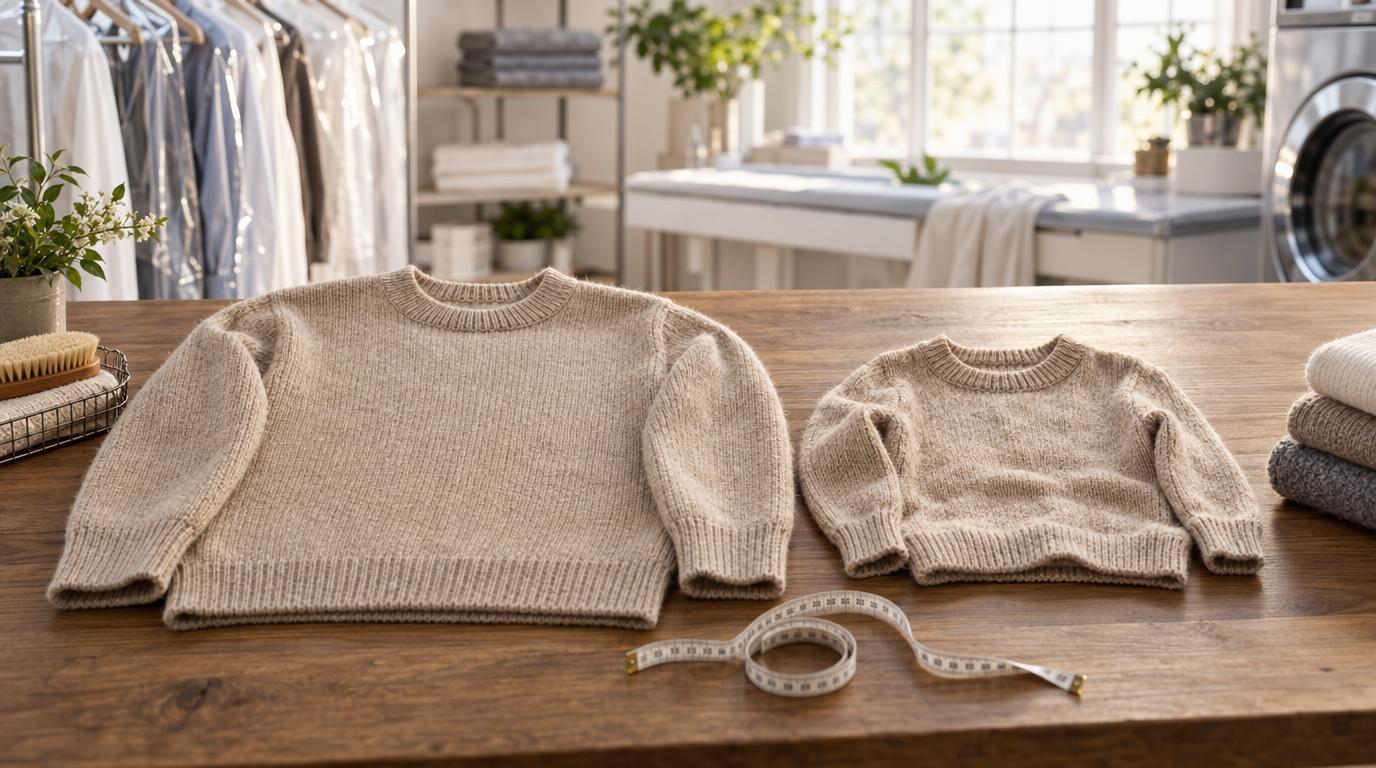
A washable sweater with modest distortion may improve after label-safe dampening, gentle blocking and full flat drying. Blocking means guiding a damp knit toward its intended outline without hard pulling. Record the starting dimensions, move small areas evenly and let the garment dry before judging fit. A felted sweater, heat-glazed synthetic or weakened seam may not recover through reshaping.
Surface pills can be addressed only after the knit is clean and stable. Use a clean sweater comb or guarded shaver with light, short passes while the garment lies flat. Work away from seams, embroidery, loose loops and already-thin zones. If the face catches or a long fiber begins to lift, stop. A small remaining pill is less damaging than a new run created in haste.
Return the sweater to storage in working order
After wear, note stains while their source and location are still clear. Clean the sweater by the label before long storage and let it become fully dry and cool. Fold it with the shoulders aligned, place detachable pieces together and keep heavy garments from pressing deep creases into the knit. Hanging a substantial sweater can lengthen the body and distort the shoulder line.
Inspect the storage area if an animal-fiber piece shows grains, webbing, shed fiber or small holes. Isolate the affected garment from nearby wool and cashmere. Cleaning can remove soil and address the garment as part of the response, but holes and weakened yarn need a separate repair decision.
Questions we get before a deadline
Can I make a stretched sweater smaller in the dryer?
Do not use the dryer as a sizing tool. Heat and tumbling can create uneven contraction, felting, surface roughness and added pilling. If the label permits a specific tumble-dry setting, that direction applies to routine care, not an uncontrolled rescue. Keep the sweater flat and request an assessment when its proportions have already changed.
How early should I check a sweater for an event?
Check it as soon as the date is fixed and again several days before wear. The first inspection leaves time for cleaning, complete drying, repair review and a second fit check. Bring the whole coordinated set and give the exact wear time at intake so the ready time reflects the work actually required.
Can pilling be removed the same day?
Timing depends on whether the pills sit on stable, clean fabric and whether stains or weak yarn are also present. Grooming before approved cleaning can hide soil or stress the surface. Staff should inspect the knit before a ready time is promised. Do not rush with a razor or scissors because one caught loop can become a visible run.
For a sweater deadline, call (818) 557-0276 or book a pickup; the ready time is confirmed after inspection.